
By Richard A. Becker
February 28th, 2026
In memoriam Marc Diaz
We sail within a vast sphere, ever drifting in uncertainty, driven from end to end.
—Pascal
Time Is A Lit Fuse
Our experience of life is inextricably bound to time. If we must define time in a single way, we can call it the sequence of changes that occur in the material, perceptible universe. The metabolic processes of life are broadly explained as chemical, thermal and electrical changes. Because thought and emotion are generally regarded as subsets of these changes, our minds and feelings, including the essential “ego” or “sense of self,” are also linked to the passing of time. All of this is seemingly obvious, because with the exception of certain strange episodes in our lives, we are keenly aware that time passes.
When energy is slowed sufficiently and connects itself to other slowed energy, these wave/particle packets become matter in its various forms. (Solid, liquid, gas, plasma, etc.) They retain order and integrity for a duration of time dictated in part by their environment, but inevitably entropy, random forces and directed forces demolish matter and change energy into an unusable thing. All of this occurs over time.
Our bodily needs go through cycles. The sun journeys across the sky. The moon, planets and stars wheel in the night sky, and around us the environment changes with Earth’s revolution and the tilt of its axis as it rotates. Each moment is perceived to some extent and memories are formed, each to be revisited (and, perhaps, revised) in the endless now of our existence. To change over time is to live, to become unchanging is something else.
The natures of time, energy and consciousness do not seem to be completely identical, but they are inextricably linked. We can simplify the great mystery of energy by saying that it is the potential for anything to happen in the universe—the possibility of action (change), including the actions of living and experiencing being alive. We can broadly simplify the even greater mystery of time by offering the childish (but hopefully forgivable) analogy that energy, as it is expended to cause action, requires the medium of space to give it some place to do what it does, and time to give action a beginning, middle and ending. Energy sits waiting, is ignited in stars and growing seeds and embryos, burns for a duration in time and then ceases to be useful—to be able to perform actions. The heat in our blood and the flick of the lizard’s tail are the actions of endless tiny fuses set to burn in time. To Ovid, time was the devourer; if it is, its jaws are only the snuffing of a flame.
And consciousness? Consciousness is the phantom we may find the most difficult to truly comprehend; for the purposes of this essay, it is touched on the least, or perhaps in the least satisfying way. To live and to think demands the burning of energy in time and space, but what more this could mean is a matter we can still only gesture at broadly. Perhaps it means nothing more. Or perhaps consciousness is itself the shadow, or reflection, of something not held within the confines of time, space, matter and energy as we know them.
If you are alive, conscious, perceive your own self and perceive the universe, then you at least experience the present. If your mind forms and retains memories, you have a sense of a past. If you can speculate on what might happen, or might have happened, then your imagination gives you a perception of a future. Humans tend to think of non-human species as lacking one or all of these senses, but there is little or no reason to believe this is the case. Perceiving time and its passage is a tremendous advantage for survival and quality of life in a universe where time is a factor in literally everything that happens. An organism that didn’t experience time at all would need to be so simple and hardy that it could survive without knowing what is happening to it, learning anything from what has happened to it, or having any idea what might happen to it in the future. That’s a very limited idea of being alive.
Time Is A Lifetime
We have no direct knowledge of a time before our conscious existence, beyond artifacts of light from long-dead stars and relics of our ecosphere from the childhood of Earth… and, of course, our many histories, archives and treasured potsherds, bones and antiques from the tiny sliver of time in which the human species has existed. We bravely speak of carrying on millennia-old traditions, with no real idea what they were like when they began, and shout with great authority of the characters of people we know only from speeches, diaries, letters and old furnishings. If we are lucky, there are paintings and sculptures; if we are luckier, they’re not images created by artists trying to flatter their patrons into a particularly nice bonus. And all of this mass of knowledge is unwieldy enough that no single human mind can hold it all, or much more than a small specialty within it. The telescope with which we gaze across the sea of the past is rather cloudy, with a sad tunnel vision, and most of us never try to look through it anyway.
The hidden truths of the history of the non-human world are even more obscure to our eyes. How many fallen trees shaped lakes by diverting rivers? How many roots and insect tunnels broke rock into dust and joined it to make fertile plains of soil? Never mind all the roads and dams and dredged harbors, how much of the land all around us is the ancient architecture of creatures whose lives we hardly notice at all? Human life is not necessary to the existence of time itself, nor the experience non-human life has of time. The human experience of life itself is bounded by time, and possible only because of time’s passage, making us only fellow voyagers in the river of time as it flows on and on to an unknown sea. We look upon stars and dinosaurs and microbes and passenger pigeons in their course, and in them we see our own ongoing voyage as well.1
All this being said, we are left with a great mass of biases, grievances, guilts and holidays to remind us of the silent majority—the generations that have died before us—which conceals the truth of our experience of time: That it is now. No matter the modern wonders of recorded images and sounds, we only live in the same moment as those who are alive while we are alive. Our only truly meaningful ancestors are the forebears who live now and have been alive in our own lifetimes. Beyond that great-grandmother who died when you were a toddler, you never saw the world of her time. Beyond that grandfather who told you stories when you were a bored teenager, you never lived in his world. History may shape borders and lift flags, but it is only the stage on which the living strut and fret until their own brief candles are extinguished in turn.
We give ourselves anniversaries, birthdays, holidays and observations of the changing of the year to remind ourselves that time matters. It is a way of underlining the number of heartbeats we’ve experienced, and how many heartbeats we believe remain to us. Special occasions are a memento mori with a smiley face on it. Tempus fugit, O tempus fugitive.
The essence of meaning and how it relates to time is similar to the old saw about whether or not trees make noise when they fall if there is no one to hear them. Time might exist in a lifeless universe in which no organism ever lives and nothing is there to perceive time, but so what if it does? If such a hypothetical desert universe existed, undiscovered and unobserved, it would be meaningless to any life form. Imagine a watch buried hundreds of miles under the surface of the Earth, unseen and imperceptible. What time does it show on its display? Who cares?
The tick-tick-tock of the stately clock as it stands against the wall, the skritch skritch skritch of the prisoner’s nail counting off the days until his execution, and the lub-dub lub-dub lub-dub of your heart as you sit and breathe and think… they all remind us: Live an hour or a hundred years, for you and everyone else, time is a lifetime. But it isn’t all that time is.
Time Is A Circle, Like The Dial Of A Watch Or The Orbit Of A World
Our collective experience of time, and one of the fundamental introductions we have to an empirical universe in which we exist, is the set of cycles that govern time on our planet in particular. The Earth revolves around our sun, Sol, in an ellipse—a shape somewhere between an oval and a circle, but which we tend to simplify into a circle. During our orbit around the sun, the Earth rotates repeatedly, tilting on its axis like a spinning top. The result for all life on Earth is an ever-changing pattern of stars in the sky and a wheel of seasons that literally moves us away from or toward facing our greatest energy source, the sun. Earth’s revolution yields four general seasons, though they’re not identical in both northern and southern hemispheres at once, for obvious reasons. We move from cold into warmth into heat into warmth and then back into cold, repeating onward into the future. This is Pascal’s vast sphere within which we sail, driven from end to end—the uncertainty he ascribed to us was not a matter of time’s known patterns, but the unknown shape of the future we experience.
When we consider the ellipse of our orbit as a childish circle, one that brings us round to the same place where we saw the first pattern of stars and planets every 365.25 days, our four seasons seem less arbitrary. We did not choose to live on a circle moving in a circle around a circle, but we can try to understand this fascinating existence—to systematize it. Measuring the “movement” of celestial bodies across the sky, we see the proof that our world moves like a wheel around the hub of our sun.
A wheel of seasons, then, is joined by a ring of hours in the day. Earth itself is roughly spherical, and approximately 24,000 miles (12,750+ kilometers) in diameter—a circular diameter of 360 degrees. The speed of Earth’s rotation is such that we may divide 24,000 miles into 24 hours, and in each hour this planet rotates on its axis 15 degrees. Each hour can be further divided into 60 minutes, and each minute into 60 seconds, all of it visible to one degree or another on a sundial—a circle, and the original model of clocks and watches. As the world rotates, we move from cold into warmth into heat into warmth and then back into cold, repeating onward into the future. Life is born, attains maturity, procreates, ages and dies, repeating onward into the future. A cycle that exists in time and initiated and governed by the availability of energy.
The precarious nature of life on Earth is built on many foundations of shifting sand. A thin layer of arable soil, a fragile web of ecology, a balance between purer and more polluted environments, population sizes and more—but over all hangs the cycle of energy from the sun, and the behavior of the atmosphere and water cycle that tempers it. Time is impartial: If your planet’s atmospheric gases are of the correct balance to properly mitigate the sun’s energy, you will experience this over time. If the atmosphere is changed, then whatever outcome this imbalance causes will also be revealed through time. Time is the render of the veil, the bringer of apocalypse, revealer of the truth.
The shape and rhythm of time is inarguable. It is not the reason why Newton and others sought to clarify history by pinning down exact dates for the acts of Romans, Greeks and others. Those historical researches were inspired by a need to know what human beings did with their time. Paleontologists and geologists do not ransack the buried treasures of the Earth in search of time itself, but rather what living things and great natural processes did throughout time in eons before humans ever existed. Time is a circle, and its fundamental mystery is one of the least studied things in human endeavors. We usually wish to examine the furnishings of time’s great mansion, not its foundations. It’s only recently that physicists have given it a fuller examination.
Time Is Now And The Now Of Memory
Mental health researchers inform us that the human mind needs a solid orientation on time and its passage. To live without a sense of any potential future is crushingly hopeless and anxious. The absence of a sense of the past leaves us unmoored, disconnected from others and any clear identity, and bereft of emotional stability. And obviously, if we could not perceive the moment in which we exist, we would face the same issues of dread and confusion, but all the more so if this disjointed existence was as literal as we can imagine. To never truly “be here,” but only have memories of what we have done, may or may not describe our actual consciousness—there is significant lag time between what happens around us and how our brains process it and act upon it. But if we could truly notice this delay between stimulus and reaction, we might be unable to function at all.
There are many who argue that we must live in the moment, but they don’t seem to be describing a state in which we disregard past and future entirely and perceive nothing but a constant Now. Their real meaning seems to be that we spend much of our lives in contemplation of past, future and countless possibilities and impossibilities, rather than focusing entirely on the very moment in which we live. “Live in the moment” is more of an exhortation to “LIVE” than to experience only one “MOMENT.” Functionally, of course, to be entirely consumed by the present is to have only the most tenuous connection to past memory and future potential—continuity would exist, but a blazing world of intense interaction with life and reality would shout down stray thoughts and idle rambling.
Neuroscientists have stated with confidence that when we remember things we have experienced or observed, imagined or had related to us, we recreate each memory anew every time we return to it. Memories thus become copies of copies of copies, but they are the copies made by metaphorical scribes, each adding some form of scribal error to the memory. Memory is, therefore, said to be unreliable. It seems to work well enough for neuroscientists to perform neuroscience without having to re-study everything they know every day, to say nothing of jet pilots and firefighters and particle physicists and prima ballerinas. And when we are deeply anesthetized or extremely intoxicated, many of us carry on coherent conversations and find our way up three flights of stairs to our own hotel rooms, without our brains making a single memory of the actions we undertake in time. So perhaps we may be a little too alarmed about the unreliability of memory.
That being said, it is clear that memory is—rather than being our personal time machine—more of a notepad on which we sketch a map of our experiences. We aren’t very good cartographers and we don’t completely understand how to read these maps, but thanks to the use of language, we have backups for these dubious documents. The backups are also dubious, of course, as witness the many changes of epochal texts such as the Christian and Jewish Bibles over thousands of years, and the Victorian scholar Dr. Bowdler was very proud of his zealous efforts to “cleanse” our collective memory system. But anyone who has been transported out of their present day and into the fixed memory of a written text will attest that we also experience time in ways that are more reflective of abstract inner life than material functions.
And when we do things, memorable or dull, we multitask by also making memories of the things we do. Or do we? Are the experience and the creation of memory united into one thing? Apocryphal quotes claim that Sartre told us that “to be is to do.” He probably didn’t say so, but the nature of how we experience time is fairly well encapsulated with those words anyway. “Exist” is also a verb, and even when we take no other actions, we exist—and make memories—and may take action, in a secular trinity that cannot readily be divided. Remember a moment ago, when you read that previous sentence? Now you remember reading about reading it. Oh no, reading about reading about reading about… Memory and experience in time—it’s a recursive thing, if you look at it the right way.
All of this having been said, the role of time in perception and consciousness is fairly unambiguous. Anything that can be perceived, as far as we know, is perceived by means of the senses, which operate over a duration of time. The eyes detect light, the ears discern sound, and so forth—and every stimulus takes time to move to the sensory organs, and time must pass for the sensory organs to gather and transmit data to the brain and central nervous system. And anything we can “perceive” in the sense of cogitation, intuition and realization, must be the result of time’s passage. (It takes time to think.) Even the storage of our memories of what we perceive requires a certain amount of time to pass, both for the creation of the memory and its recall. On a sensory and intellectual level, perception and consciousness require time. Even sensory data, such as random noises, and language-free “vibes,” take place over varying periods of time.
But the question remains: Why should we care? Doesn’t everything happen whether we measure how long it takes or not? Barring practical considerations, like the time it takes for a fuse to burn or for an apple to spoil, isn’t it really a vain pursuit to spend part of the limited time in which we exist… by pondering the limited time in which we exist?
The Dawn Of Time And The End Of Time
Faith begins where Reason sinks exhausted.
—Albert Pike, Morals and Dogma
Science and faith share a common feature, which does not make them identical in any way. Both proceed from certain assumptions, without which the exercise of these ideas is impossible. Whether you argue from mathematical proofs and reproducible experimental results, or from emotional and intuitive “gnosis” that you feel has revealed dimensions of existence beyond reason, intelligent life is systematic in its thinking. When a cosmological idea is too vast—generally matters of infinity and of the nature of existence and nonexistence, but there are others—it becomes untestable. We cannot really know the answers to certain questions beyond inference and theory, unless we argue from assumptions.
The idea of the universe springing into existence out of a primordial void is quite old. The ancient Greeks believed Chaos was the prime mover; the Norse called the first darkness Ginnungagap, while the Egyptians were terser and simply called it Nun. While others, like the Chinese and Babylonians, held that something must come from something, and had the universe birthed from an egg or a sacred marriage of god and goddess, the human tendency to think of the world as a disordered jumble that needs to be set in order was enshrined in the religious notion of darkness giving birth to light—something from nothing. Of course, some envisioned it in multiple ways, as in the ancient Vedic traditions of Hinduism, and a strong case can be made that the God of the Book can be interpreted either way: As a something from which something (the universe) arose, or as a silent void (nothing) from which something arose.
All of this relates to modern questions of cosmology and of the nature of time itself. The Big Bang theory is increasingly doubtful, to most students of physics though it obviously parallels both ancient ideas of a universe born from chaos and equally old notions of a universe-birth from a cosmic egg. “Fiat lux” would be equally appropriate to whichever interpretation—if there was still any way to think of the entire universe as definitely having a beginning and an ending. But if the universe isn’t a finite span of time that bursts out of non-time, then what is its temporal nature?
It is easier to try to explain the universe if we conceive of it having a Big Bang and Big Crunch than to think of it as having no beginning or ending. That is an idea that flies in the face of entropy itself, the burning of the lit fuse of time. It isn’t hard to imagine a universe that begins with energy and then runs out, leaving death, darkness and cold forever. But visualizing one in which there is existence despite an infinite amount of entropy to precede our time boggles the mind. How could our known universe not already be a scattering of dead carbon and thermal radiation if it’s already existed forever? And if the answer is that matter and energy “restart” themselves with a Big Bang/Crunch cycle over and over forever, that implies that the second law of thermodynamics is somehow only temporary, which is also mind-boggling.
The major living religions are adherents of the Big Bang/Crunch cycle or creatio ex nihilo, however they choose to label it. God or gods set everything into motion—the religions of the Book call it Genesis, the old faiths didn’t have such fancy names—and then, when the whole story of life is told, the will of the divine brings it all to an ending. Call it Ragnarok, or what have you (“Apocalypse” really doesn’t mean “end of the world,” nor does “Armageddon”)—the basic idea is that all of existence has a birth, a childhood, a maturing and a death, or if you prefer, a spring, summer, autumn and winter. An arisen god of life that dies with the winter, such as Christ or Osiris or Mithras, is identified with the waxing and waning of the farmer’s crops and the way they feed the community. Life is a cycle, for man and god and universe, and that cycle is a thing made of time.
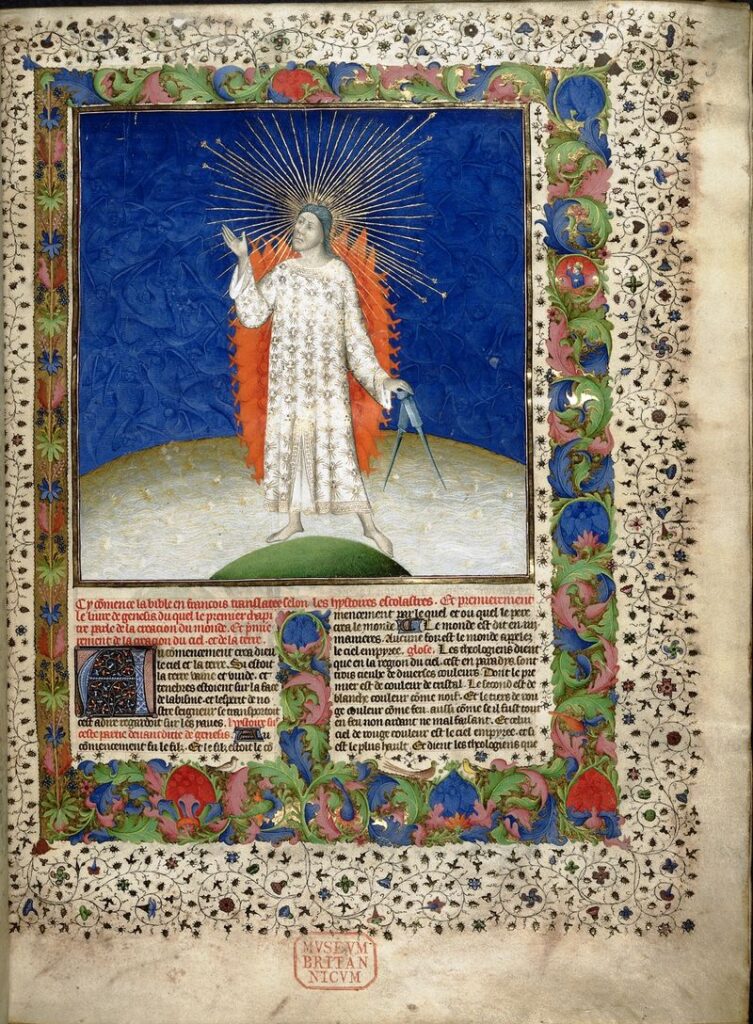
Strangely, this means that in one sense, much of science and faith share the idea that existence is inextricably tied to time. (Time is sticky, to borrow a term from economics.) Prophecy means nothing if there is no time before and after its fulfillment, and without time itself nothing can happen—not even thought-experiments. Couched in this set of assumptions, it’s easy to see why so many people dread a thing no human being has ever experienced: Eternal life. What could it be, but an endless unspooling of time, experience that goes on forever, in which the only hope is the limitation of memory? The only mercy would be forgetting the countless lifetimes you’d already experienced and treating each new packet of time as if it was entirely new. Perhaps this is what Buddhists and Hindus dread in the concept of Maya, of never-ending reincarnation and a hopeless infinite cycle of attachments and feelings that mean nothing except in the moment.
Perhaps, fundamentally, time must either be a strange and singular burst of existence that has a beginning, middle and ending, like a story, song or lifetime. Or, perhaps, it is an infinite loop of bursts of existence, in which our only hope is to forget and cling desperately to Now.
Or, perhaps, there is something else.
Eternity, Or Time Tamed
To see a World in a Grain of Sand
—William Blake, Auguries of Innocence
And a Heaven in a Wild Flower
Hold Infinity in the palm of your hand
And Eternity in an hour
There are, generally, two ideas of what eternity must be. These ideas are not mutually exclusive, and could theoretically coexist.
The first is that it is nothing more than the unspooling of an infinite thread of time—time that goes on without interruption or conclusion, forever. Seen in this light, eternity could be viewed as the suppressor or purveyor of time, a supernatural force that has power to tame time. Much has been made of the awe-inspiring scale of such a cosmic timeline, as well as the hellish boredom that an immortal being would face if they existed within it. Certain interpretations of Hinduism and Buddhism argue that the impulse to escape the endless cycle of desire and action is an urge to escape a hell of infinite time and the maddening repetition and boredom that such a condition would engender in any thinking creature.
In a biological sense “Time is Tight,” as the song goes, our earthly existence bound by a finite number of days. Flesh and the material world are by nature at odds and hard to reconcile with the heady concept of infinity. If tangible matter could exist in an eternal state, it suggests regenerative ability that conjures up the philosopher’s stone. In any case, matter alone is not absolute. Religion overcomes this with the belief in Heaven and Hell, repositories of eternity but with the caveat that one is eternal bliss, the other eternal torment.
An immortal creature in our nontheological scenario would be one that could never succumb to entropy—starve, suffocate or otherwise die—but which still existed in the known physical universe, interacting with everything in it perpetually for as long as there was a universe to interact with. Some think that this would be a perfect embodiment of the aforementioned hell of infinite time; others breathe a sigh of relief that the human brain, at least, could only record a limited (but very large) set of memories and that this kind of immortality be fairly theoretical even for the immortal person. You might have done anything three thousand years ago, they argue, but since you couldn’t remember anything more than a couple of hundred years, it would only be words on papyrus to you. (And perhaps other, more tangible artifacts, but you get the idea.)
It is often postulated that infinite time would be accompanied by a physical universe of the kind we know and experience, with matter and energy and consciousness going through their appointed rounds faithfully until all energy is consumed and change ends—the heat death of the universe—and then there is a new contraction of Everything That Is, and bang! It all starts over again, over and over and over. Assuming this has no more persistence of memory than the human brain in our previous discussion, it would be functionally identical to a “once around, then it’s over” span of finite time. If memory and experience are bounded by time, what does it matter if time itself is an endless scroll of change? As a fictional character once said, “A difference which makes no difference is no difference.”
The second is that, to paraphrase Wittgenstein’s discussion of the matter, eternity is a condition that exists outside of time’s passage. It is hard to imagine existing in this state. Time is the grammar of causality, as Y happens at Z o’clock because X happened, and if there is no time, then there is no order for things to exist or not exist, occur or not occur. Everything would happen at once, and/or not at all; everything would exist at once, and/or not at all. Non-temporal eternity is an idea more alien than any notion of time travel or parallel time-lines. Wittgenstein thought of it as an eternal Now, but that seems to simplify the idea for the sake of comfort and familiarity. To always live in the Now is not the same thing as to exist in a form that has no causality; one in which everything that is possible is happening at the same time and in which things that could exist are both present and absent at once—since there is no moment at which they are created or destroyed.
Wittgenstein frames the question as a choice. Eternity is either a boundless forward motion, more of the same thing heaped upon more of the same thing forever, or as some unimaginable condition of existing outside of time and without need for time.
If non-temporal eternity is real, it may be something that a human (or similar) mind is already adjusted to experiencing without knowing it, and which can only be appreciated by direct engagement. (In other words, you might have a “third eye” to live comfortably in non-temporal eternity without realizing it, in the same way that you have little direct experience of your appendix.) On the other hand, sapient life may be flatly unable to perceive and experience non-temporal eternity, and life itself may be our experience of time. If we are pessimists, we may believe that life is our experience of time, and that when our body stops functioning, we cannot experience time—and, therefore, anything. If we are optimists, we may conceive of the idea that we experience existence one way or the other, and that when our bodies die and we no longer perceive time, we become attuned to a non-temporal eternity in which we somehow exist “outside” time. It is impossible for the living to know which is true, if either of them is anything more than speculation.
An eternal being that existed outside of time would be judged rather harshly by creatures, such as ourselves, who dwell within time. We would ask—if you see all that has happened, is happening and will happen, perceiving all of it clearly and completely and in a single perspective, then why have you let things proceed as they do? We can only move from past to present to future. Why would we accept an eternal figure choosing to let us act out our tragedies and disasters without interfering, when every facet of these terrible things would be within their power to change from outside? Unless, of course, there is no way to change outcomes without taking part in the process of time. Then an eternal entity could know everything within time—if that is their nature—but be no more able to affect timebound things than you or I can reach into Dali’s paintings and change the time displayed on his melting watches. Our memories melt like clock faces rendered in oil on canvas, but in a timeless eternity everything is always NOW.
Or perhaps a timeless eternal entity would resemble the Celtic legend of the púca, a playful spirit that can stop time, move forward or backward in time, and move at impossible speeds because for them speed = any distance / purely optional time passing. They might dance and play like dolphins in a sea of eternity while chuckling and splashing the dull prisoners aboard the plodding ship of time.If matter or energy could exist in eternity-as-infinite-time, it would be mind-boggling. Eventually, there should be neither matter nor energy, if entropy is constant and irreversible and if the sum of all matter and energy is finite. If entropy is not constant, or is reversible, or if the vast quantity of matter and energy is actually infinite, we could call such a cosmos nothing short of irrational and potentially supernatural.
If matter or energy could exist in eternity-as-non-time, the results are no less staggering. The implication would be that neither time nor the effects of things happening in time were the defining traits of matter or energy. Things alive and dead would be as constant and ineffable as Plato’s ideals or a Bodhisattva watching over mankind. A tiny grain of sand on a distant beach would be as significant as a god or a universe. Everything would simply always BE, and nothing would ever really not exist. The ramifications are vast and absurdly complex. And that’s before we learn whether or not there are any conditions attached to transitioning from existing in time to existing in eternity. What if only some things are eternal? What if only one thing is eternal? What if there is some process involved in becoming eternal that is as indescribable as the religious idea of an object ceasing to be mundane and becoming supernaturally holy? (There’s a good question. Could we time transubstantiation with an atomic clock, and know the precise fraction of a second that a pool of water ceased to merely be water and became holy water? Or a religious convert ceased to be an unbeliever and became blessed by their faith?)
It should be noted that this essay does not assert any positive claim about the existence or nonexistence of consciousness separate from the material body, or about its potential survival in some form in some version of eternity. A theist would strongly argue in favor of the existence of a soul of some kind, while an atheist would insist that there is no possibility of a separation between mind and body or any existence that transcends the material. As an agnostic, I offer no positive conclusion on these topics, in large part because I think no one knows, has known or ever will know positively the absolute nature of reality. Instead, the broad topic of time and the narrower topic of how we exist within it raises many fascinating questions, most of which have answers we cannot know now. (Or, possibly, ever.) Faith within reason is perfectly acceptable for many people, but the lingua franca of reasoning, cooperative humans must be rationality and materialism. With a solid grounding in humane and just values—but that is a topic for some other essay.
The idea of divine time would be better expressed as a timetable and master plan than as an abstract flow of time. The religious will often argue that everything happens for a reason, leaving silent their insistence that the reason is their god or gods. To interject this author’s viewpoint in a nutshell, I find it very easy to believe that everything happens for a reason, but impossible to believe that everything happens for a purpose. A reason is an explanation. A purpose is a plan. They are quite different, and unless there are a vast number of purposes that are meaningless to the human mind, there must be many things that occur for no purpose at all—but always with a reason that they occurred.
If a monotheistic deity (as one example) existed, and existed eternally without beginning or end, we could reasonably assume that such an entity would not directly understand what it was like to live within the flow of time. Never born of any womb, never going to any grave, free of hunger and fatigue, without itch or belch, it would be utterly different in so many ways. Living things’ minds are shaped by their experience of their environment and themselves. Any being that was constantly everywhere, in everything, in all times, yet was distinct from everything and did not actually change in the medium of time, would be too alien for full human comprehension—and vice versa. It might have a great deal in common with humanity. So might all conscious things. It may be that tarantulas know love, and that chunks of granite feel impatience, and that a single drop of water may conceive the existence of the value of pi in the brief instant that it is separate from the ocean. But in so many ways, these non-humans would know and experience non-human things. And so, we may assume, would a deity of any sort.
So, again, we must accept that if time is our way of describing the change we perceive in the universe—all of it, within and without ourselves—then for entities that do not change in the same ways we do, time could not exist. But we have never truly described such beings in any of our writings. Even a god who has no beginning and no end spends a week building reality; even a god on a high mountain acknowledges there have been many ages of the world and that he was only a divine king after elder times had passed. Hinduism grasps at the idea, but Kali cannot have a Kali Yuga if time does not pass for the divine ones. Tempus divinum is a very abstract idea in every system of spirituality; the most that can be said is that some entities are said to be immortal and to be rather like a Mobius strip curving back on its own origin. But none of them act or speak like a being that knows no passage of time.
And this relates us to eternity in its most fundamental aspect: If it is real, it may be that we already exist in it, always have done so and always will do so, since it is beyond any aspect of time. But we don’t know it, and there seems to be no way we can consciously know it while we exist within the confines of a material world. Eternity is ineffable.
And what’s worse, our timepieces will not function in it, either.
Time Runs Out
We all have time to spend or waste, and it is our decision what to do with it. But once passed, it’s gone forever.
—Bruce Lee
We have considered the nature of time itself, and some of the possibilities of what a hypothetical eternity might be. We have discussed the ways in which humanity counts time and accounts for time, from history to calendars to clocks, whether they be solemn bell towers, the handmade wonders of the craftsman Masahiro Kikuno or the celebrated timepieces of the House of Breguet. Most of all, we have tried to grasp how we perceive and experience time, which is a panopticon of life itself. We have touched upon the breadth of the universe in space and time, and fumbled at the questions of deities, souls, life and afterlife. But what does it all amount to, in summation?
It’s only really a way of looking at our lives and reflecting on them. The conveyor belt of time bears us along, and we may as well take a look at it and guess a little about how it works and what it does. We’re on it, no matter what. And maybe by gaining a little perspective, if that’s what this essay provides the reader, we can more readily appreciate being alive and perceiving time. Around the world, fewer and fewer people view time through the beauty of analog clockwork of any kind. Digital displays on mobile devices and laptops dominate it all, synchronized by industry and shackled to the power of King Atomic Clock. It’s practical, and greatly useful, but it isn’t elegant. And it just may be that if we let ourselves think about what time is, and how our lives intersect with it, we can reclaim a little of the part of ourselves that isn’t a cog in a machine. Perhaps we can become more the masters of technology than those mastered by it.
These words, like all written text, defy time in a small way. For however long they can be read, these thoughts—fragmentary, scrambled and groping for vast meanings with a rather un-vast mind—will live again, in the Now of the reader’s own thoughts. A testament written in the ether, destined to be washed away by the surf of time, but the next wave isn’t due for a little while. Language is a technology, and technology is an extension of our minds and hands. We have no time machines, but we have something that eludes time for a while regardless.
Let us be sloppy as time wasted, precise as time well used, capricious as time ignored and elegant as a beautiful timepiece, each in our own way. We have only a lifetime, after all. Or, perhaps, eternity, which would mean we truly had forever and a day.
Addendum
Titian’s Allegory of Prudence
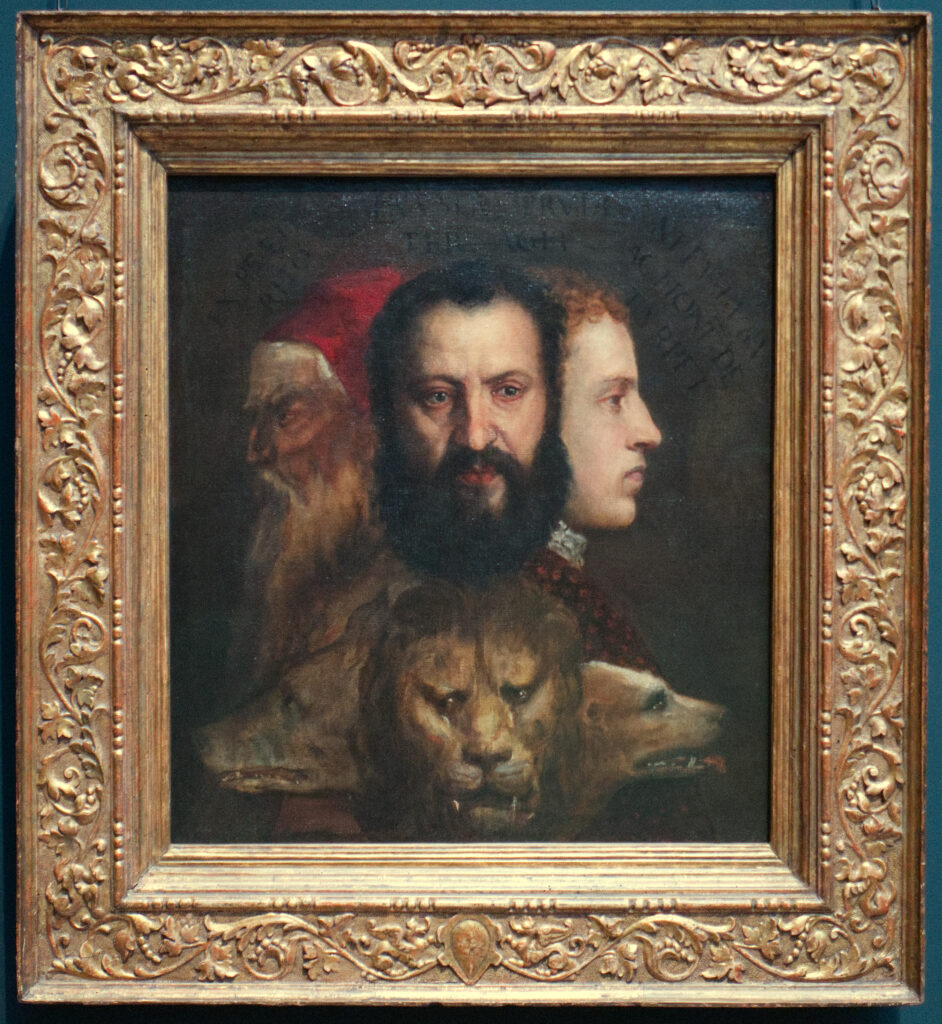
Titian’s painting depicts the Three Ages of Man, a classic motif that has been tackled by many artists. Titian first painted the subject as a young man titled The Three Ages of Man (c. 1512-14), a renaissance work in customary bold colors centered around a dramatic vanishing point. In this early work Youth is depicted by Cupid clambering over two sleeping putti on the left; Middle Age by a pair of lovers on the right; and, Old Age by a diminutive old man in the middle, distantly contemplating two skulls which could be the former lovers. The three distinct stages of birth, life and death are deftly balanced against the backdrop of a pastoral landscape. The composition works as a kind of moving image due to the non-linear placement of each stage of life, resulting in an early masterpiece by Titian. (The painting is essentially read from right to left, a device repeated above.)
Allegory of Prudence on the other hand takes up the theme one more time when the artist is a much older man. It coolly waives all customs of the period and the master plays by new rules—his own. The result is a triptych within a triptych that eschews the use of panels. Here Old Age, Middle Age and Youth are depicted right to left with Middle Age beckoning the viewer, although direct eye contact is avoided. The faces arrayed have an overtly autobiographical tone, a theory substantiated by art historian Erwin Panofsky. The old man represents the artist himself, middle age is represented by Titian’s second son, Orazio, and youth by his nephew Marco Vecellio. The trio merges into a kaleidoscope of past, present and future.
To heighten the impact on the viewer the portraits mirror three beasts below—a wolf, a lion and a dog, whose body is enveloped by a huge python. The gruesome beasts could easily be inhabitants of Dante’s Inferno, possessing a strange, lifeless quality as though they were heads arrayed in a slaughterhouse. These represent the passage of time in counterpoint to the “living” heads above and in the mythology of late antiquity, the wolf embodies the past (memoria/praeteritum), the lion the present (nunc/praesens) and the dog the future (futurum).
The many layers of meanings conveyed by the painting go further: Prudence (prudens, prwdens) not only refers to the passage of time but also stands for Memory, Intelligence and Foresight. These in turn represent past, present and future—and vice versa. The Latin author, Fabius Fulgentius, explained it as follows: “Prudence is composed of three faculties—Memory, Intelligence and Foresight—of which the respective functions are to conserve the past, to know the present and to foresee the future. Prudence surveys the tripartite span of life.” This reading is supported by a barely visible inscription above the portraits: EX PRÆTE/RITO // PRÆSENS PRVDEN/TER AGIT // NI FVTVRA / ACTIONĒ DE/TVRPET (“from [the experience of] the past, the present acts prudently, lest it spoil future action”).
In Middle English the noun prudence further stood for time, which is the German title given to the painting: Allegorie der Zeit (Allegory of Time). Titian’s simple iconography masks a complex mythology embedded in the painting. Time and memory collide to strike a cautionary note, one that requires time and prudence on the part of the viewer to decode.
Acknowledgement
Breguet Blog would like to extend enormous thanks to Richard A. Becker for authoring the first guest article to be featured on the blog. Richard is an author and screenwriter whose interests range from fiction to history. He lives and works in Burbank, CA.
Notes
All URLs correct at time of publication.
1 It is well to remember that no two moments are alike:
You cannot step twice into the same river.
—Heraclitus, Fragments
2 Moulins was a medieval monk who largely put together the first translation of the Bible into French. He did not translate the entire Bible and drawings were given to manuscript illuminators. The significance of this folio is the depiction of Deus Pater holding a dividing compass. Proverbs 8:27 writes that when God “prepared the heavens […] he set a compass upon the face of the depth” (KJV). The compass can be interpreted as an instrument of Divine Reason, a view expounded in the Book of Wisdom (11:20) which says: “But thou didst order all things by measure and number and weight.” Without time and order, the theologians reasoned, existence would be a fraught possibility.
Bibliography
BOROWSKI, E. J., & BORWEIN, J. M., Dictionary of Mathematics, Glasgow: HarperCollins (2002). ISBN 0-00-710295-X.
BUTLER-BOWDEN, Tom, 50 Philosophy Classics, London: Nicholas Brealey Publishing (2017). ISBN 978-1-473-66783-9.
DA VINCI, Leonardo, Notebooks, Oxford: Oxford University Press (2008). ISBN 978-0-19-929902-7.
KURZ, Otto, European Clocks and Watches in the Near East, London: The Warburg Institute, University of London (1975). Printed in the Netherlands by E. J. Brill, Leiden. ISBN 0 85481 053 6 / 90 04 04326 8. Plates I-XVI.LIPPINCOTT, Kristin, The Story of Time, London: Merrell Holberton (1999). ISBN 1-85894-072-9.
Article © Richard A. Becker 2026. Published by Breguet Blog on behalf of the Author. All rights reserved. For permissions, please contact us.