
By Richard A. Becker
December 31st, 2025
In memoriam Marc Diaz
Panta rhei.
—Heraclitus
An Introduction
It is appropriate for a blog that discusses the art and craft of fine timepieces to consider time and our experience of it. This essay will be unable to completely encapsulate, explain and investigate the nature of time, how we perceive or record it, and what might lie beyond it. But that’s to be expected of any brief examination of topics this immense and indefinable. Existence, perception, time and all such heady matters are greatly intertwined, and everyone from clergy to scientists to philosophers to comic book writers have tried to climb the mountain that separates us from a comprehensive understanding of how they all come together. This essay will do no differently.
But perhaps in these paragraphs a few interesting thoughts will emerge and some valuable observations will be noted.
Time will tell.
The Nature of Time
time, n. (Mechanics) a primitive term of Newtonian mechanics, represented by a single real variable and measured in seconds.
—Dictionary of Mathematics by E. J. Borowski & J. M. Borwein, 2nd Edition (2002)
infinity, n. 1. a value greater than any computable value, such as the index of the limit of a non-terminating sequence of values; this value is denoted ∞.
Time itself is simultaneously an obvious, almost instinctive idea and a dauntingly elusive one.
Time is a difficult idea to clearly quantify without becoming glib and reductive. It seems to be more of a descriptor than a thing, like the ideas of energy and life. Energy is a description of potential and active change, or if you prefer, “work.” Life appears to be a temporarily sustained, complex set of interactions of chemicals and electricity, with a handful of nearly universal traits such as consumption of outside energy, self-repair and reproduction (sexual and asexual). But time, reduced to its most basic nature, seems to be a way of describing all change in the physical universe. Living things expend energy over time, and some life forms generate memories of what has happened in time and/or imagine the possibilities of what may happen in time. All this may be true, but ultimately, time is simply change.1
As every schoolchild knows, there are formulae expressing the relationship of time to speed and distance:
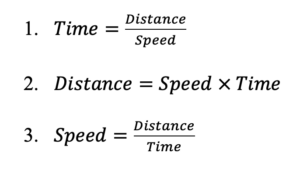
These formulae simplify the question of time sufficiently that we can understand movement in three-dimensional space, and of course, they help us calculate many necessary things in everyday life. How long will it take to get there? How far away is it, if we drive the speed limit? And so forth. Scientifically, we know that the well-proven and constant speed of light helps us to gain insights into the universe on a far more technical level. This despite the fact that light’s movement can be slowed, stopped and reversed in laboratories—a thing we might fantasize to be a trick of a devil, but is in fact nothing more than the vast complexity of the real universe around us. It’s well for us to remember that if confusion arises in our understanding of facts, it means only that our knowledge is still too limited or that our minds lack the coherence to grasp what we learn… not that supernatural forces make anything “beyond our comprehension.”
Having given this simplistic definition of time, we may briefly address what time is not. And the opposite of time, or at least one opposite of time, would be true stasis.
True stasis is a completely theoretical condition. It would be an absence of time, either locally or universally. If this occurred, no change would be possible in whatever the static object or volume of space was described. It would be the most invulnerable state anything could exist in—because no change would occur, there would be no possibility of decay, erosion, burning, explosion or any other alteration to matter or energy in that static zone. As far as we know, true stasis does not exist in nature. Even objects reduced to absolute zero temperature, in which there is no agitation of matter (heat), can still be acted upon in a fashion expected by physics. True stasis would not permit this. If such a condition could be achieved and reversed at will, it would be a perfect preservative and “escape clause” for nearly anything that could occur in the known universe. A living thing in true stasis would experience nothing, because it could not physically change in any way—no synapse would activate, no photoreceptor would register any wavelength of light, etc. It would be a kind of nonexistence.
There is no reason to believe that true stasis is possible, either by natural occurrence or through artificial means.
Time, on the other hand, is demonstrably real because change is real and constant. Perhaps the most obvious sense of time is represented by the sun and the moon, or, “the greater light to rule the day, and the lesser light to rule the night” as the King James Version puts it. But change is also local to your position in space and how far change extends in space. The light of distant stars is generated in their fusion plasma bodies, but it can only move as far and as quickly as physical laws permit. Therefore, the fiery light of a galaxy a hundred million light years away can only be seen here after it has traveled a hundred million years. Light, radio waves and voices carry—over time. Each thing, living or inert, is an island in time, isolated and united by the limitations of interaction. Even “ghostly” quantum entanglements that link particles (and possibly larger things) at long distances are not instantaneous. Like true stasis, the condition of being instantaneous does not exist in the universe as we know it. Time rules over all.
Physicists and others have advanced many theories about what exactly time really is. Leonardo da Vinci, polymath of the High Renaissance, offered his own unique thoughts on time and movement in general:
A point has no part; a line is the transit of a point; points are the boundaries of a line. An instant has no time. Time is made of movement of the instant, and instants are the boundaries of time.
—Leonardo da Vinci, Notebooks
Leonardo’s customary succinctness is a recipe all his own: profundity and brevity collide with the sensibilities of an artist and scientist of utmost exactitude. His simple observations contain the beginnings of a PhD-level thesis in physics and mathematics. Thanks to its chief characteristic—intangibility coupled with ineluctability—time may elude our grasp but where it acts upon the elements, Leonardo posited, those characteristics can be mapped and traced to chart its phenomena.
As a result of such enquiries, some believe that time is a dimension, or measurement, of the physical universe that is indivisible from the fabric of space. Gravity wells that distort space also apparently distort time, and the famous Lorentz-FitzGerald contraction that governs the passage of time as an object’s velocity approaches C (the speed of light) also lends credence to the idea of time as a dimension of space. But there are also newer theories that predict time will be demonstrated to be a separate dimension from space, and that while the two are closely linked, they are not inextricably bound together. There are even theories that time is another sort of particle in the universe, like a hadron or electron, and that it may one day be isolated and possibly even manipulated to some degree. Laboratory experiments have generated light particles that slowed to a stop or moved backward in time, and the theoretical faster-than-light particle called the tachyon is speculated to move backward in time due to its non-standard velocity.
Of course, there is also the very prevalent theory that predicts all free will is illusory, and all random things completely non-random, because time passing is an illusion of perception.2 In this scenario, every event of every scale, from the movement of a particle to the wheeling of a galaxy in the universe, is a facet of a vast, complex and possibly dazzlingly beautiful pattern that simply is. It does not begin or end, nor does anything within it. But every component in the universe is fixed and absolute—you live in the time and place where you live, do what you do, begin and end with birth and death, and nothing can really ever change. You merely experience this existence as if you were reading a blog entry about time. If you like, you could look back to the beginning of any paragraph and read it again, but as the poet said, “Not all thy piety nor wit shall lure it back to cancel half a line, nor all thy tears wash out a word of it.”
This very fatalistic (and somewhat Calvinist) way of picturing the nature of time argues that everything that ever existed still exists, untouchable by those who perceive themselves as having moved further on in time (as well as those who just didn’t coexist with earlier things), and everything that ever will exist is already there, untouchable by those who do not yet perceive them (and of course those who will die “before” those future things become part of the fabric of fixed time). Time is a garden and everything in it is a rock or tree—nothing can go further than its small appointed allotment in any direction, and everything does only what is part of its immutable nature to do.
Of course, if time moves and changes, then our perception of it as moving and changing is valid and accurate. If time only seems to move and change, but is really fixed forever, then our perception of change and movement is an illusion. We may one day find empirical proof of which theory is most accurate, or possibly some alternative will prove true, but at the moment we cannot know the answer. Since this is the case, we will examine time as if it flows and things change, cheerfully acknowledging that this may be completely untrue.
Time Travel and Other Strange Possibilities: A Tangent
Broadly, theoretical science is asking what time is, in this case. And that means that applied science would be to ask what we can do with time. And so far, the answer is: Just exist in it. But what if we could do more?
It’s popular to say that humanity is drawn to “stealing fire from Olympus” or “meddling in God’s realm” like a B-movie mad scientist, but it’s natural for a thinking creature to wonder what it would be like if things were other than they are now. This is the impulse behind both useful and harmful change, after all. But for any of this to be reason-based speculation (science fiction) or actual thought experiments for future actualities, we have to consider what’s really possible. And as living things bound up in the flow of time, it’s natural that we would ask: Could we control time? Or move through it in exotic ways?
The potential for time-controlling technologies fascinates scientists and laymen alike. Time machines and time travel through faster-than-light movement are favorite ideas to ponder, and recent crazes for the many-universe theory of quantum mechanics are based on the idea that time somehow splits into “timelines” based on individual choices or even merely actions. If these multiverse ideas hold true, there might be an infinite number of universes that exist in separate timelines—independent continuities of existence—for no more reason than that a subatomic particle went left rather than right in a cloud of gas in a galaxy a hundred billion light years from Earth. Differences would exist that were so subtle no human mind could hope to perceive them, yet they would spawn new infinities more easily than you might blink an eye.
Or perhaps not.
There are faint glimmers of hope in real life of actual time manipulation and travel. They are very, very small glimmers. Photons of light have been arrested in their movement in something resembling true stasis, or “sent backwards in time” in a way that beckons to the possibility of time travel in at least one direction. Theoretical faster than light drives, such as the Alcubierre drive, might one day permit us to overcome the surly bonds of Einstein’s theory of relativity and warp our way across interstellar distances. Maybe.
Experiments at the Steinberg Lab at the University of Toronto in the 2020s have indicated that at a quantum level, photons interacting with atoms demonstrate a different way of “experiencing” time than at larger scales of the universe. It’s sometimes called “negative time,” but it’s more of an effect of quantum mechanics than the time travel this term would indicate. This not to say there haven’t been particle physics experiments that have shown strange anomalies in the nature of time at very small scales, but it shouldn’t be interpreted as a basis for time travel at any scale of the universe.
Physicists generally believe that a sub-microscopic “basement stratum” of reality, a “quantum foam,” is the true foundation of our universe. It is theorized that particles of matter and energy pop into and out of existence in this invisible realm, some persisting and interacting with the rest of known reality and some vanishing into—whatever is the opposite. What would time be to a simple particle that exists for a tiny fraction of time, appearing from seeming nothingness and then returning to that state? It’s unimaginable, really. We might think of it as a time capsule of forever, or as the poet would have it, “The universe writ in a grain of sand.”
Among the strangest discoveries in quantum mechanics has been a series of physics experiments in which it appears that time may be causal in two directions, with future events affecting past events as well as the more “normal” order of past altering future. This is, of course, on a very small and ephemeral scale, but it calls into question the absolute nature of time’s tyrannical march from past into future at any scale. Part of the underlying and somewhat uneasy nature of mere existence is the persistent sense that reality is arbitrary, which is oddly part of rational thinking. There is no “why” two plus two equals four, it simply does. This tends to lead some to magical ideation, and arguing that if one arbitrary thing is true then any arbitrary thing might be true. It can lead to religious enthusiasm as a way of avoiding the existential uncertainty of living in a continuum of It Just Works That Way. But all we can really say is… if It Just Works That Way, we’re not completely certain what That Way is.
It may be one day that we develop technologies that enable us to take shortcuts in time, like cryogenic or other suspended animation. Or we could possibly escape the Lorentz-FitzGerald contraction by building spacecraft that warp space in a bubble and move that bubble (and the ship in it) faster than light. These things are reasonably conceivable, if variably far-fetched. But to stop time, or speed it, jump sideways into parallel universes or move backward and forward in our own “timeline?” All of these things would depend on a much greater understanding of our reality and how time works, and we’re nowhere near any of that right now.
Better to return to the topic at hand—time as we know it, and the ways we know it.
How Do We Measure and Record Time
What is a meter?
—Alexander Grothendieck, Letters
Grothendieck’s question is surprisingly simple yet it highlights the problem plaguing less-than-tangible ideas such as time, times and distances. A standard of measurement is nevertheless necessary if we are to function in society. The earliest notion of time is literally night and day, the cock crow, church bells, the Adhan—simple, low-tech methods that work. More high-tech methods emerged when the Babylonians invented the sundial (Herodotus, II, 109). It was adopted by the Greeks who placed them in public and affixed them to buildings, also developing portable sundials. The Egyptians contributed the water clock which indicated the time at night and when the sun was not visible. These were the humble beginnings of tracking the days and the nights, later to be subdivided into hours and minutes and ever smaller increments of time.
In a colloquial sense, there are “many kinds of time,” but of course this is only a description of the ways in which the passage of time is measured and recorded. Because no one knows exactly what time is, in a concrete sense, it is impossible to authoritatively say if there is only one time—a single facet of reality, with a single way of being and doing—or two, or a few, or many. While we will briefly examine the different ways to measure and record time, we will treat time in this essay as a singular thing, indivisible in its fundamental nature. We could say, “Time is time,” at least for argument’s sake.
We measure time by measuring things that happen in time. In atomic clocks, for example, we harness the principle of consistent, regular emission of radiation emitted by atoms. We know how long the intervals of these emissions take to occur, and by mechanically detecting the emissions and counting them, we very precisely measure the passage of time. This is different in scale and mechanism from the old days of counting time with wax candles marked for the duration of melting an inch of wax, but the underlying idea is no different.
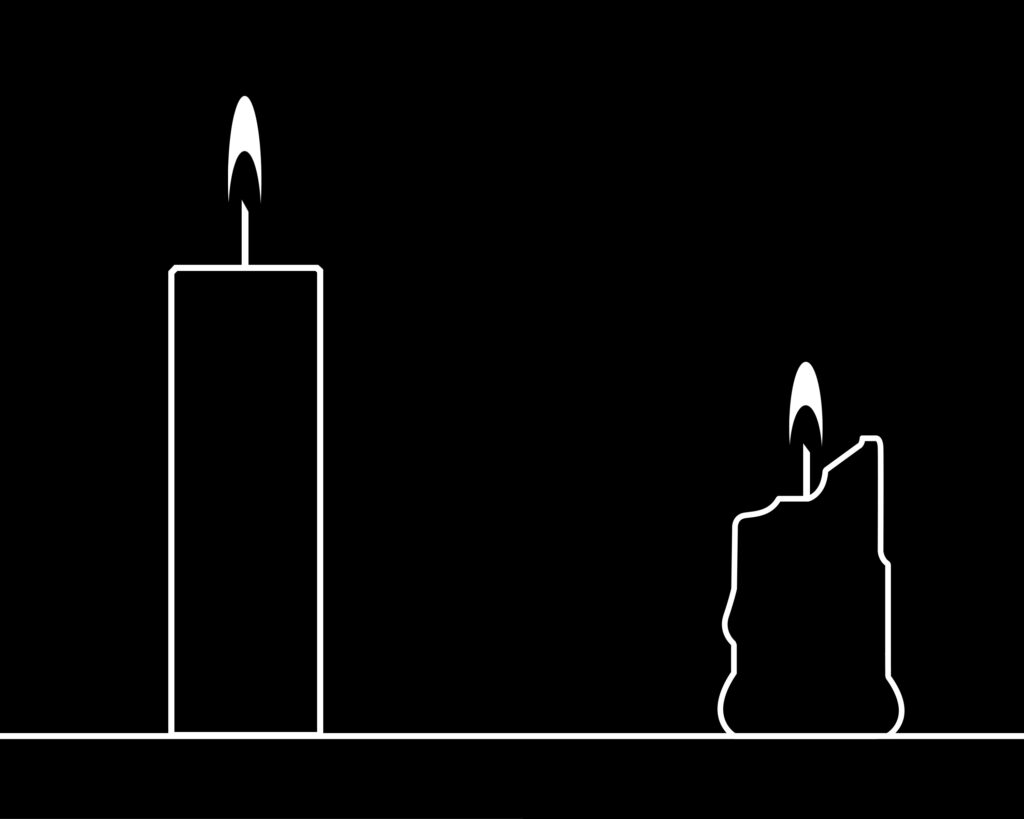
Our units of time measurement are designed for different purposes and degrees of accuracy and scale. Planck units of time are the smallest, and are (as a very simplistic explanation) based on the time it takes light to travel through an absolute vacuum over the distance of a single Planck unit of length—the smallest measurable unit of length. (Any smaller than this scale, and physics becomes incomprehensible.)
The Calendar and The Clock
Our principal instruments for measuring the passage of time are the calendar, used for the counting of days into weeks, weeks into months and months into a year, and clocks—be they mechanical or digital—which tick away seconds into hours and hours into 24-hour days.
The most widely used calendar is the Gregorian calendar, established in 1582 by Pope Gregory XII. It replaced the old Julian calendar, and counts the 365 days of Earth’s revolution around our sun, a star called Sol. (Prompting one of Earth’s other names, “Sol III,” due to our occupying the third orbital position from Sol.) This calendar adds a “leap day,” once every four years, to account for the fraction of a day “extra” in every Earth-Sun orbit. There are other calendars, such as the Chinese, Islamic and Jewish calendars, all of which are lunar systems like the defunct Julian calendar. Certain Christian holidays, mainly Easter and its sequence of holy days, are also on a lunar calendar and do not match Gregorian parameters. But the Gregorian calendar is broadly accepted as the world standard.
Clocks count out time in a format called Civil Time. Civil Time measures the period from one noon (apex point of the sun in the sky) to the next, dividing this into 24 equal hours of 60 minutes, and each minute into 60 seconds. In the United States, a century-old (failed) scheme for greater efficiency called Daylight Savings Time requires 49 of the 50 states to change the numbering of the hours on clocks twice per year, to little positive effect. (If any.) Calendar watches include the date. Then you have perpetual calendar watches that, if kept wound and on time, only need their year resetting every few hundred years or so—very practical for those who will be around to do the winding.
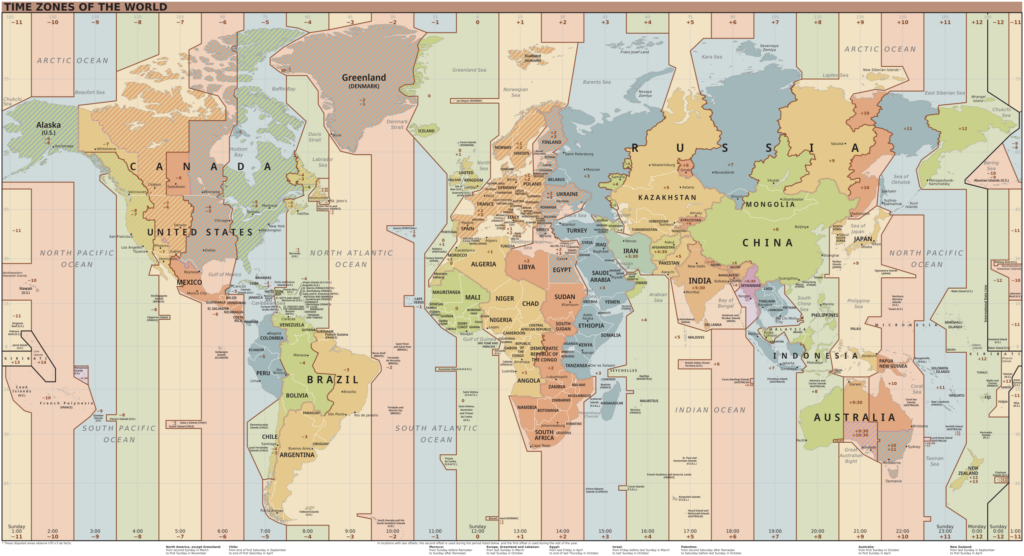
A related term is Solar Time, which is divided into Apparent and Mean Solar Time, but like Civil Time these are descriptions of time based on Earth’s movement relative to its sun. (There is an Equation of Time that reconciles the difference between these two types of Solar Time.) The details may be useful in specific applications, but for the layman there is no practical need to understand more than basic Civil Time. Universal Time (UTC) is little more than Civil Time for astronomers, basing its measurement on instruments based in Greenwich, England. It is the replacement for Greenwich Mean Time (GMT), because UTC is based on the pulses of an atomic clock. But the atomic clock pulse measurements are organized in units of seconds, minutes and hours in a 24-hour day, so the difference here is only one of precision. As the universally accepted global standard, the following map of the world’s time zones is worthy of study:
Astronomers and astrologers make use of Local Sidereal Time, which is counted by measuring the relative movement of a star in the sky. Cosmologists working within the theoretical framework of a Big Bang origin for our universe (an origin not at all certain at the time this article is written) have devised a system of Cosmic Time, a complex idea of “absolute time” that ignores the expansion of the universe in the Big Bang model. It is applicable to calculations of things related to that cosmological model, but not to very much else. A few expensive clocks/watches display the equation of time, which is a fancy way of saying a mechanical movement that tracks the actual difference between mean and solar time (around 16m ahead in November and 14m behind in February). It’s also a mechanical way of keeping track of astronomical time.3
The space sciences have made it clear that time is absolutely essential to their celestial subject matter; distances between stars are often referred to as light years (the distance light itself can travel in one terrestrial year) or parsecs (“parallax of one arcsecond”). The delays of radio waves and other signals in crossing the enormous distances of outer space are well understood in this field and demonstrate the importance of time to it. But if we view the question of time in a religious sense, it becomes more grounded. The ancients who composed the texts and tales of faiths forgotten and continued were greatly interested in time, and we find that the God of the Book is as much the author of time itself as the Fates of the old Greek and Norse beliefs. Most religions throughout history have subscribed to the idea of time as having a beginning, middle and ending.
Clocks fixed in place and clocks we wear—watches—are designed to count off Civil Time for the most part, with specialized cosmic complication watches made to measure astronomical cycles such as moon phases as well as Local Sidereal Time. There are no time pieces for Cosmic Time, of course, as it is a system of theory.
Calendars, artifacts and various forms of documentation are used to measure and chronicle the age of human activity, both recorded in history and reconstructed from artifacts of prehistory. The complementary disciplines of history, archaeology, paleontology, paleobotany, etc., mesh together to slowly generate a picture of the actions of human life on the surface of Earth since we emerged from proto-human predecessor species. Supernatural explanations for the arrival of modern humanity are dwarfed in scale by these studies of radioactive carbon dating, genetic history, physical relics and cave paintings, and even today we continue to revise the known age of homo sapiens as a species. We appear to have walked the Earth far longer than we previously believed.
Appendix to all of this is history, the collective extension of human memory. It is the preamble to our lives, and the archive in which our stories will rest after we die. We find history in parish Bibles with pages of names and births and deaths, in a census like the Domesday Book or a clay tablet with invoices for copper ingots. It is written in the fossils and finds that demonstrate how deaths and changed births lead to natural selection for better survival in a changing world. We find it in a biosphere and landscape that are shaped by living organisms and raw natural forces, as well as the diaries and letters of dead generations. History is a fragmentary, groping, contentious narrative, arguing with itself as our memories do about what exactly happened and why. Much is known and much is unknown, which is little different from our grasp of the entire contemporary world around us.
Nevertheless, the popular Gregorian calendar is associated with a western timeline fixed on the presumed birth year of a religious figure, Jesus Christ. His historicity is unproven and his birth year undocumented, but western culture measures historic time based on an arbitrary assumption of his advent into our world. This leads us to the two sections of history/prehistory in western reckoning: Before Common Era (BCE), very often known as Before Christ (BC), and Anno Domini (AD) or “year of our Lord.” There is of course no “year zero” separating the two periods, and decades are counted in years 1-10, such as 2001-2010, and bundled into 100-year centuries, which are then batched together into 1,000-year millennia.
The matter is made somewhat confusing because this timeline is organized like a number line of negative and positive numbers—the further back into time you count, the higher the number of the year (so that 100 BCE is much earlier than 1 BCE), and the closer to the present you count, the higher the number of that year (so that 2025 CE is much later than 1 CE). But again, unlike a number line, there is no year zero, so that if you wanted (for example) to denote the decade of the 1980s, you would list the years 1981-1990. The year 1980 would be the last year of the 1970s, and the year 2000 would be the final year of the 1990s.
Beyond this, specialized scientific measurements are used to calculate Deep Time, both in the form of Geological Time—the physical record of Earth’s planetary formation and geological metamorphosis—and astronomical studies of the visible age of the universe. (Which may or may not be its actual full age.) Like every other system of organizing the measurement of time, Deep Time is based on things that happen in time. Thus, the current geological eon—the Phanerozoic Age—has no specific ending in time, but like all previous geological eons it will be bounded by some significant major geological event occurring.
In the novelty pop song “Particle Man” by the band They Might Be Giants, the lyrics tell us that Particle Man has a watch he wears that has a minute hand, a millennium hand and an eon hand. We can safely assume that the minute hand is ticking away steadily, while the millennium hand has ticked over once in our own lifetimes (if we were alive in the year 2001) and we have no way of imagining when or if the eon hand will ever change its position. But I’m sure Particle Man’s watch will work when it’s appropriate.
Fun excursions into theoretical time-keeping aside, what is very important to note is that all of these are systems for measuring, counting and recording time. But none of them alter how we experience time.
And how we experience time is by experiencing anything at all.
Time, Perception and Experience
Cogito, ergo sum.
—Descartes
Conscious entities perceive and experience time as an element of simply existing. Heidegger calls this state Dasein—“being”—a concept inseparable from the perception embedded in Descartes’ famous dictum. Being aware allows us to “be” and the state of awareness or perception is known in German as Wahrnehmung. All these states are instrumental in creating a thinking mind, which in turn leads us to feel an acute sense of time when we reflect on the past, present or future.
Fortunately, this essay will make no effort to establish serious definitions of either consciousness or existence, both of which are greatly contested subjects to this day. Consciousness itself (or sentience, if you wish) is often accused of being purely illusory, and if it does exist, we have no real certitude whether only humans possess it, as only two examples of how these topics are debated. For the purposes of discussion, consciousness is simply the “I am” underlying our every thought, feeling, memory and perception. Existence is the act of being conscious in the material universe. As for thought, feeling and memory, these require little definition, though memory will be considered throughout. Perception is another matter, as it encompasses not only sensory input but our interpretation of sensory input. It also touches upon the continuity of the internal “I am” of consciousness, and how we sense the passing of time even as nothing in particular is happening to or within us. Perception is subtler than most of us think, but it could only survive a cursory discussion herein, so it will also—mostly—be left in the simplest terms.
Still, it is difficult to distinguish clearly between the idea of consciousness—”self-awareness”—and the idea of “existence,” which is to say, “to be a real thing that exists.” Reality is that which exists, perception is knowing interaction with reality, and consciousness implies that when we (or other self-aware things, if there are any) turn our gaze inward, we perceive something there that is real. (A “self.”) The terms are resistant to further reduction beyond this point, with the caveat that individual perception is not empirical proof that a thing is real. We may perceive things incorrectly, or hallucinate them entirely, leaving our only genuine tests of reality as either a) Shared perception (“We cannot both hallucinate an identical thing”), b) Measurable interactions with material things accepted as real (“I can hallucinate it, but it cannot leave clear footprints or DNA evidence and be a delusion”), or c) Scientific hypotheses extrapolated from previously tested data (“If these observations are correct, as we have tested and checked them to be, then it is highly likely that Planet X is real and not a delusion. But we must still test the claim of Planet X’s existence.”).
Life expends energy to undertake action of all kinds, including the actions of existence itself and of the perception of the universe in which one exists. Action is change effected upon matter and unused energy, which requires time as well as effort. It’s one thing to imagine a tree falling and no one (nothing?) being present to hear it, but without the passage of time the tree does not fall—and nothing else can happen either. Viewed in this way, we can see that without time, life is not possible. Is the existence of time itself inextricably linked to the perception of time? It does not seem so, though the reverse is certainly true. Nothing needs to experience time in order for it to exist, because a lifeless complex of matter, energy and space could and would continue to act in mindless ways regardless.
Are existence and perception possible without happening within the medium of time? If they are, they would take some form we, who live within time, cannot imagine. (Or perhaps it would be a familiar condition, one underlying our everyday consciousness, in the same way we overlook the sound of our own heartbeats or the peripheral sight of our own noses between our eyes.)
Science has determined that life itself has multiple possible avenues of arising spontaneously in the universe, with a minimal stimulus, thus requiring no particular intelligence to author it. The building blocks of life are abundant in the cosmos and the random energy that could spark it into originating and developing further is commonplace. Even this, of course, is no death blow to the idea of supernatural creation. After all, an imperceptible and all-powerful being, or even one much less powerful, could be the prime mover of the many avenues for life to generate itself. Unfortunately, this is also no support for intelligent design—the God of the Gaps is an untestable assumption. And either way, life happens.
We perceive time by noticing change in ourselves, other living things and in the environment we share. Sensory perception is key, but inference may be even more important. To see a cliff’s edge finally give way, let a rock fall and then see the rock hit the bottom of the cliff is certainly a sequence of events, but without senses of causality, speed of action, object permanence and some abstract notion of time (even if it’s only the existence of memory), there would be no idea that the rock fell from the cliff as an event within the flow of time. There would also be no way for an organism to estimate whether it was fast enough to pounce on prey or cross a dry waste to reach a watering hole. A bird could not time its landing on a tree branch swaying in a breeze. On some level, we must infer the existence of a dimension of time. Some basic understanding of time’s existence seems inherent to many living things, for many of the same reasons most animals have some sort of depth perception. The continuing function of life without a sense of time would be difficult, if not impossible.
The rate of change within our metabolisms dictates much of our experience of time. The well-known experience of “adrenaline slow-motion” is an immediate example of this. Science has also shown us that animals with faster metabolic rates live in a slowed-down world, due to their shorter reaction times, and the reverse for slower organisms. Even plants, nearly all of which are fixed in one place and react to changes in their immediate environment rather than changing location, must have some way to respond to time. Just as plants orient their growth to the direction of gravity, their growth and other physical changes are tied to the cycle of energy (more or less sunlight) in their environment. One might argue that detecting levels of energy availability is not a perception of time, and is only a simple metabolism responding to day/night and seasonal cycles. But if one strips away the senses and memory generation of animal life’s time perception, plants’ responses aren’t as different from animals’ interaction with time as it might seem.
Examples have arisen in anthropology of uncontacted peoples who claim to have a very different perception of time, but it is difficult to know whether this is a real distinction in how they experience existence or if it is a matter of semantics and philosophy. It is very nearly impossible to imagine humans without a sense of the passage of time—if nothing else, we would know it from the boredom of periods when nothing very engaging happened. But this is not the same as having a different mindset for structuring time, whether it holds a practical difference or not. There are cultures that claim to think in long-term strategies, yet their outcomes are very similar to every other culture’s. There were Europeans in the past who split their nighttime sleeping into two halves, waking in between, but this isn’t functionally very different from working a swing shift of some sort. Change the calendar, wake with the sun and sleep with the moon, however one divides time up and takes its measure, we still all live one split second to another.
The sum of our memories and the limits of our bodies also influence how we perceive time, as children know from the endless cycle of a single year and older people know from the faster and faster passage of time after the apex of middle age. Even our engagement with life affects our perception of time. Douglas Adams informs us that “time is an illusion; lunchtime doubly so,” and that is glibly funny yet also somewhat true. Extreme conditions of life—whether exhilarating, grueling, tranquil or any other—seem to last longer or shorter, and in some ways that appearance is a reality. You can check your watch or calendar all you like, but how you live through time is your real understanding of it, not your accounting of it.
We often imagine time to be a progression of past into present into future, but our experience of it is stranger and more immediate. While we generate and review memories of things past, and imagine (with varying degrees of realism) things that may occur in the future, time is more accurately an ongoing present from which things depart (in one way or another) as they end and arrive (again, in one way or another) as they begin. Events preceding living memory are to some extent imaginary, just like hypothetical future ones, and even things we do not personally witness are colored by our speculation.
The old adage holds that time flies like an arrow, and philosophy tells us that it’s most logical for time to have a single forward direction. But this is what creatures who exist moving forward in time would consider logical, whether it was or not, and it is not the only way time might move. Like the many things we cannot see with our human eyes, but which nonetheless are quite real, our perception of time is useful and practical to organisms in our environment. It is not an absolute or complete understanding of time itself.
It has been argued that time itself is a colonialist/imperialist idea, a “Western” idea, but this is more of a description of how we count time and how we account for ourselves in time. Cultures are shaped by what we do with time, but time is sufficient unto itself and cares nothing for oppressor or oppressed, emperor or subject. When it is time to breathe and blink, you will do these things no matter your language, diet or inherited physical traits. You might live in a place, and among people, in which you do not need to set an alarm clock and tell others what work you have done to prove your value to other human beings. But that will not free you from the progression of change in the material universe. There is no culturally based way to escape the dominion of time, any more than one could be born into a society that has no aging or death.
To be continued in Part II.
Acknowledgement
Breguet Blog would like to extend enormous thanks to Richard A. Becker for authoring the first guest article to be featured on the blog. Richard is an author and screenwriter whose interests range from fiction to history. He lives and works in Burbank, CA.
Notes
All URLs correct at time of publication.
1 An earlier definition was given by Aristotle:
[…] time is the calculable measure of motion with respect to before and after.
—Aristotle, Physics (4.11.219b1)
If change is motion and vice versa, then change must be defined in order to give us the instrument for creating “yardsticks” to measuring anything. Change is therefore best described as frequency, see:
frequency, n. 1. the number of times that an event occurs within some given unit period; the rate of occurrence.
—Dictionary of Mathematics by E. J. Borowski & J. M. Borwein, 2nd Edition (2002)
2 Albertus Magnus, or Albert the Great (ca. 1193-1280), a doctor of the church, devoted much time to thinking about and reflecting on time and memory and how this plays upon our perception of the world around us:
Time is perceived (sentire) in twofold fashion. One way is in itself (in se), according to a reckoning of its movement. Only rational beings perceive and know (cognoscere) time in this manner. In another way time is perceived relationally and not according to itself; then it is perceived according to a fixed distinction of time, according to which a time is located near a temporal event.
—Albertus Magnus, Commentary on Aristotle, On Memory and Recollection, trans. by Jan M. Ziolkowski (2002)
3 Breguet has produced some exceptional Grandes Complications equation of time watches in recent years, notably ref. 3477BR/1E/986 available in rose gold or platinum at a diameter of 35.50mm; followed by a high-tech, contemporary sports watch, the Marine Tourbillon Equation Marchante ref. 5887 available in rose gold or platinum at a diameter of 43.9mm.
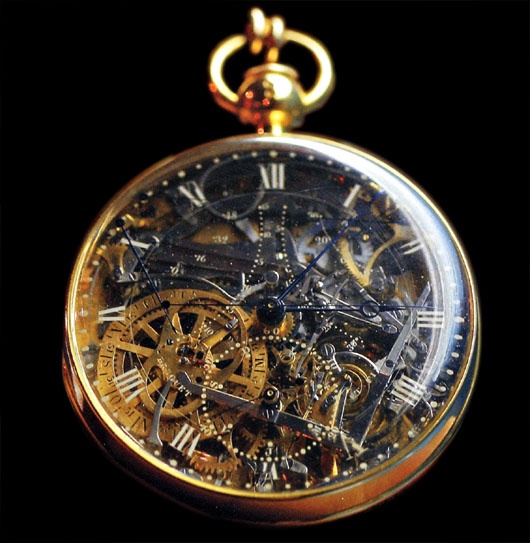
4 A superb history of Breguet’s mythical pocket watch is given here by Emmanuel Breguet: The “Marie-Antoinette” watch No. 160.
Bibliography
BOROWSKI, E. J., & BORWEIN, J. M., Dictionary of Mathematics, Glasgow: HarperCollins (2002). ISBN 0-00-710295-X.
BUTLER-BOWDEN, Tom, 50 Philosophy Classics, London: Nicholas Brealey Publishing (2017). ISBN 978-1-473-66783-9.
DA VINCI, Leonardo, Notebooks, Oxford: Oxford University Press (2008). ISBN 978-0-19-929902-7.
KURZ, Otto, European Clocks and Watches in the Near East, London: The Warburg Institute, University of London (1975). Printed in the Netherlands by E. J. Brill, Leiden. ISBN 0 85481 053 6 / 90 04 04326 8. Plates I-XVI.LIPPINCOTT, Kristin, The Story of Time, London: Merrell Holberton (1999). ISBN 1-85894-072-9.
Article © Richard A. Becker 2025. Published by Breguet Blog on behalf of the Author. All rights reserved. For permissions, please contact us.